
Photo detail / credit: Whale off the coast of Provincetown, United States – Thomas Kelley on Unsplash
This is a new, exciting, and increasingly-applied concept
where nature is treated as a partner and allowed to flourish
By giving ecosystems the space and protection they need from human exploitation, nature becomes a critical ally in ensuring the survival and well-being of both urban and rural communities, as well as human civilization as a whole.

Photo detail / credit: Cheetah, Samara Karoo Reserve
A NEW THINKING IN CONSERVATION:
FROM VICTIMS TO HEROES
Animals and Ecosystems Now Seen as Key Players in Climate Solutions.
MEASURING
ACC BEING MEASURED AROUND THE WORLD
The Yale/GRA ACC model, which quantifies the positive climate impact of restoring and protecting wildlife populations, is currently being applied across multiple rewilding landscapes worldwide.
In addition to the Yale/GRA model, several other advanced models will be incorporated as part of the Climate Wildlife Hotspots initiative, further refining and estimating the CO2 capture potential of wildlife populations. Together, these tools will provide a comprehensive approach, positioning ecosystems as powerful solutions to both the climate and biodiversity crises.
Further peer-reviewed results from these efforts are expected soon.




representation in educational and global applications.

Dugongs – Bahrain
Peer-reviewed study
2.4x more carbon capture
when Dugongs are present in Bahrain’s seagrass.
546,000 tonnes of CO₂ /year
Target species:
Dugong dugon
Area considered:
145 km2
Ecosystem type:
Seagrass
Geographical target area:
Coastal waters of the Arabian Gulf surrounding the Kingdom of Bahrain

European Bison – Romania
Peer-reviewed study
18% more carbon capture
when European Bison roam across grassland and forest ecosystems in the Romanian Carpathians.
Target species:
European bison
Ecosystem type:
Temperate grasslands & open-canopy forests
Geographical target area:
Carpathian Mountains
Read more soon

Pumas & Guanacos – Chile
Peer-reviewed study
1.27–2.5x more carbon capture
when Pumas & Guanacos are present in a grassland ecosystem in Patagonia National Park, Chile.
Target species:
Guanaco, Puma
Area considered:
467 km2
Ecosystem type:
Temperate, Patagonian grasslands
Geographical target area:
Patagonia National Park

Pumas, Jaguars, Deer, Peccaries – Mexico
Peer review pending
3.2x more carbon capture
when carnivore species (Jaguar and Puma) and their herbivore prey species (White-tailed Deer and Collared Peccary) are present in tropical dry forests of Mexico.
Target species:
Jaguar, Puma, White-tailed Deer, Collared Peccary
Area considered:
18,389 km2
Ecosystem type:
Dry tropical forest
Geographical target area:
Data from shrub and forest habitats in central and southern Mexico

Forest Elephants – Cameroon, Gabon & Republic of Congo
In progress
1.77x more carbon capture
when Forest Elephants are present in the Tri National Dja-Odzala-Minkébé region.
Target species:
Forest elephant
Area considered:
178,000 km2
Ecosystem type:
Tropical rainforest
Geographical target area:
Tri National Dja-Odzala-Minkébé (TRIDOM) region of the Congo Basin

Pumas & Capybaras – Argentina
In progress
Target species:
Puma, Capybara
Area considered:
To be defined
Ecosystem type:
Subtropical wetlands
Geographical target area:
Iberá wetlands, north-eastern Argentina
In addition
We are currently reviewing the impact of Savannah Elephants in Zimbabwe, Saiga Antelopes in Kazakhstan, Invasive Rat removal in island ecosystems, and American Bison in Canada.
If you have a candidate species or ecosystem that you would like to assess using the model please get in touch.
MEET OUR CLIMATE HEROES:
Born to naturally capture carbon
Our ACC research identifies nine key species that have been extensively studied and shown to significantly reduce emissions, collectively capturing over 6 billion tonnes of carbon dioxide annually – rivaling many of the IPCC’s top mitigation measures.
Protecting and restoring a broad range of wild animal species contributes to CO2 sequestration in their own way and these 9 highlighted climate heroes have already demonstrated measurable impacts through robust research.
Research must continue beyond these 9 species to reveal wildlife’s vital role in maintaining balanced ecosystems.
Learn how the key species naturally absorb CO2, just by living their best life in the wild
RESULTS ARE IN!
A peer reviewed study published in Nature Climate Change Vol 13 in March 2023 demonstrated how protecting and restoring the following 9 species can draw down
6.4 BILLION TONNES OF CO2 ANNUALLY

WILDEBEEST
in the Serengeti
4.4 Megatons of CO2/y
or 28% of the total fossil fuel emissions by Tanzania in 2021 (13 MtCO2/y)
(1 Megaton = 1million tonnes)
Photo detail / credit: Wildebeest, Maasai Mara, Kenya – Sutirta Budiman on Unsplash

SEA OTTERS
in British Columbia
5.2 Megatons of CO2/y
or 8% of the total greenhouse gas emissions by British Colombia in 2021 (62 MtCO2/y)
Photo detail / credit: Sea Otter, Elkhorn Slough, California – mana5280 on Unsplash

GREY WOLF
in boreal Canada
260 Megatons of CO2/y
or 47% of the total fossil fuel emissions by Canada in 2022 (548 MtCO2/y)
Photo detail / credit: Canadian Wolf
– Andrew Ly on Unsplash

MUSK OXEN
in arctic mire ecosystems
30 Megatons of CO2/y
or 75% of the fossil fuel emissions by Norway in 2022 (40.9 MtCO2/y)
Photo detail / credit: Musk oxen, Norway
– Neil Burton

MARINE FISH
about 90% mesopelagic
5.5 Gigatons of CO2/y
or twice of the total fossil fuel emissions by EU-27 in 2022 (2.76 GtCO2/y) or 3.9x total by Africa in 2022 (1.42 GtCO2/y) (1 Gigaton = billion tonnes)
Photo detail / credit: Duskyshoulder trevallies, Indonesia – Milos Prelevic

SHARKS
across the world’s coral reefs
108 Megatons of CO2/y
or the fossil fuel emissions by Kuwait in 2022 (109 MtCO2/y)
Photo detail / credit: Tiger shark, Bahamas
– Gerald Schömbs

AFRICAN FOREST ELEPHANTS
in the Congo Basin Forest
13 Megatons of CO2/y
or 4x the total fossil fuel emissions by the DRC in 2022 (3.6 MtCO2/y), or almost double that of Congo (7.4 MtCO2/y) or 1.4x that of Cameroon in 2022 (9.6 MtCO2/y)
Photo detail / credit: African forest elephant
– Robin James Backhouse

AMERICAN BISON
in prairie grasslands
595 Megatons of CO2/y
or 1.08x that of the total fossil fuel CO2 emissions by Canada in 2022 (548 MtCO2/y) or 12% of the USA (5,057 MtCO2/y)
Photo detail / credit: Bison
– Pete Nuij on Unsplash

BALEEN WHALES
in the Southern Ocean
0.62 Megatons of CO2/y
in whale carcasses alone, or 70% of ther total annual fossil fuel emisssions of French Polynesia (0.87 MtCO2/y)
Photo detail / credit: Whale
– Elianne Dipp on Pexels
Healthy and diverse populations of wild animals in their natural habitats lead to healthy ecosystems
+
Healthy ecosystems lead to increased CO2 capture and storage (sequestration)
=
Protecting and restoring abundant wild animal populations and intact & functional ecosystems leads to increased CO2 sequestration
IMPACT
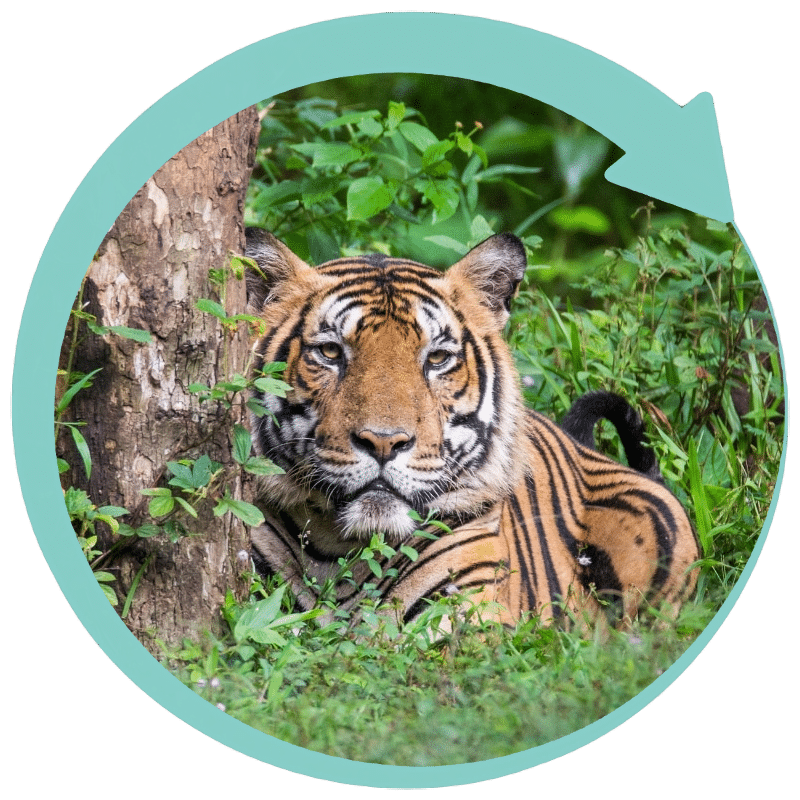
Photo detail / credit:
Girishacf from Getty Images
MAY 2025 – TIGERS AND CLIMATE:
FIRST-OF-ITS-KIND RESEARCH IN ASIA FINDS A DUAL WIN FOR NATURE AND CLIMATE POLICY
1.5 to 2 X
Carbon storage
160 million tons (0.16 Gt)
Annual CO2 uptake in forests with tigers
Professor Oswald Schmitz, from Yale School of the Environment and a co-leader of the Animating the Carbon Cycle initiative
WHERE NEXT?
Share climate heroes’ stories
to inspire change
Discover the science that
underpins ACC
Find answers to
common ACC questions
SCIENTISTS & ORGANISATIONS BEHIND

This initiative is led by a partnership between the Global Rewilding Alliance and Yale School of the Environment.
This work would not have been possible without our Rewilding Champions. A great thank you to:
Biophilia Foundation, Rewilding Europe, Rewilding Chile, IFAW, André Hoffmann, Ben Goldsmith, Re:wild. We also want to thank One Earth and the WILD Foundation for helping us get started on his important initiative.
Together, this coalition advocates a very clear solution: preserving intact nature and immediately restoring and rewilding functional ecosystems at landscape and seascape scale. You can find out more about us here.